
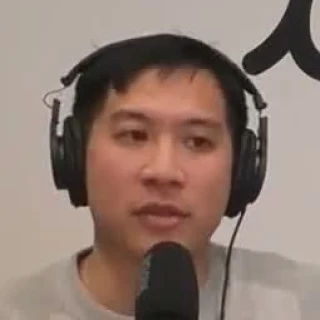
Kevin Wang

Chief Product Officer, Braze · 1 appearance on the record.

computed by AI from the episodes · how this works → · full disclaimer →

executiveoperatorLinkedIn ↗braze.com ↗

Kevin Wang is the Chief Product Officer at Braze, which he joined as an early employee in 2012. He scaled the company's product and R&D functions through its initial public offering.

7statements → 6claims → 5claims resolved → 100%fully supported → 4/5average certainty → 2/5average debate potential → 1said about them ↓

5 supported 0 partly supported 0 contradicted 1 not checkable as stated how the 6 claims stand · each chip opens the sources

6 assertions · 1 insight · every statement was checked. The predictions and assertions are the 6 claims: statements the public record can support or contradict. 5 are resolved, and 1 names no date, number or outcome precise enough to check. Everything else (opinions, insights, what ifs, disclosures) can never be settled by the record, so it carries no assessment.

The record, in short

What the tape says about how Kevin argues and how the claims held up. Everything they said, and everything said about them, is in the tabs below.

Their most notable supported claim

Assertion Supported
Wang: Deep Self-Supervised Method Beats SOTA on Goal-Conditioned RL Significantly
“We do achieve state-of-the-art performance on goal-conditioned RL and Jack's CCRL by a significant amount.”
Kevin Wang Dec 31, 2025 ▶ 21:24 [NeurIPS Best Paper] 1000 Layer Networks for Self-Supervised RL — Kevin Wang et al, Princeton

Expressed certainty vs assessment result

none yet certainty 1
none yet certainty 2
100% certainty 3
100% certainty 4
100% certainty 5

weighted support: a fully supported claim counts one, a partly supported claim counts half. Each filled bar is clickable and opens exactly those claims; "none yet" means nothing said at that certainty level has resolved yet

Everything Kevin Wang said on Latent Space that made the record, most notable first. Filter by type, assessment or year in the ledger →

Insight
Kevin Wang: Cross-entropy trajectory classification enables scalable deep reinforcement learning
“I think it's because we're fundamentally shifting the burden of learning from something like, Q-learning or, like, regressing to, like, TD errors, which we know is quite spurious and noisy and biased, to fundamentally, like, a classification problem. We're try…”
Kevin Wang Dec 31, 2025 ▶ 9:56 [NeurIPS Best Paper] 1000 Layer Networks for Self-Supervised RL — Kevin Wang et al, Princeton
Assertion Supported
Wang: Deep Self-Supervised Method Beats SOTA on Goal-Conditioned RL Significantly
“We do achieve state-of-the-art performance on goal-conditioned RL and Jack's CCRL by a significant amount.”
Kevin Wang Dec 31, 2025 ▶ 21:24 [NeurIPS Best Paper] 1000 Layer Networks for Self-Supervised RL — Kevin Wang et al, Princeton
Assertion Supported
Kevin Wang: Scaling RL network depth unlocks effective batch size scaling
“We notice that we see that scaling width actually also improves performance, and we also find that actually by scaling depth, we actually unlock the ability to scale along batch size as well.”
Kevin Wang Dec 31, 2025 ▶ 22:38 [NeurIPS Best Paper] 1000 Layer Networks for Self-Supervised RL — Kevin Wang et al, Princeton
Assertion Supported
Kevin Wang: 1000-layer RL networks can train on single 80GB H100
“The nice thing is that all of our experiments, even the thousand layer networks, can be run on one single, 80 gigabyte, each 100 GPU.”
Kevin Wang Dec 31, 2025 ▶ 24:19 [NeurIPS Best Paper] 1000 Layer Networks for Self-Supervised RL — Kevin Wang et al, Princeton
Assertion Not checkable as stated
Wang: Traditional value-based reinforcement learning fails to scale
“And so what we did is that we know that traditional RL, like let's say like value value-based RL doesn't really scale, right? This is pretty clear from the literature.”
Kevin Wang Dec 31, 2025 ▶ 4:29 [NeurIPS Best Paper] 1000 Layer Networks for Self-Supervised RL — Kevin Wang et al, Princeton
Assertion Supported
Wang: 64 layers saturate performance in most reinforcement learning tasks
“Within our paper, like, for most environments we are able to, like, saturate, like, get to, like, almost perfect performance within just, you know, we don't even need to get to, like, a thousand layers. Like, maybe just 64 layers, for example, is sufficient.”
Kevin Wang Dec 31, 2025 ▶ 15:25 [NeurIPS Best Paper] 1000 Layer Networks for Self-Supervised RL — Kevin Wang et al, Princeton
Assertion Supported
Wang: GPU environments collect hundreds of millions of RL timesteps hourly
“With these, like, GPU accelerated environments, we can collect hundreds of millions of time steps of data within just a few hours”
Kevin Wang Dec 31, 2025 ▶ 17:43 [NeurIPS Best Paper] 1000 Layer Networks for Self-Supervised RL — Kevin Wang et al, Princeton

The other half of the tape: Kevin Wang's own voice is left out of every number here. 1 statement on the record names them. every mention, with the transcript →

Statements about Kevin Wang, by other people (1)

Assertion Supported
Eysenbach: Scaling RL depth requires combining depth with residual connections
“And if we just made the depth bigger, it makes it worse. If we just add residual connections, it didn't make it better. And it was really this combination of factors that Kevin and Ishan figured out that really made this work.”
Benjamin Eysenbach Dec 31, 2025 ▶ 5:56 [NeurIPS Best Paper] 1000 Layer Networks for Self-Supervised RL — Kevin Wang et al, Princeton

Appearances (1)

EpisodeDateSpeaking time
[NeurIPS Best Paper] 1000 Layer Networks for Self-Supervised RL — Kevin Wang et al, Prince Dec 31, 2025 11m
Made with StarZero

Turn any episode into a week of clips.

This entire site, over 200 episodes transcribed, diarized, checked and made playable, runs on the StarZero media pipeline. Drop in your own episode and the podcast clipper finds the moments worth sharing, cuts them, captions them, and reframes them for every feed.